Functional Classification of Robot Covers
Date:2026-08-03 Author:Truman Robotics Visit:1927
Industrial robots work in diverse and complex factory environments, ranging from clean assembly workshops to high-temperature welding stations, flammable spraying booths, corrosive chemical workshops and ultra-low temperature cold warehouses. A single type of robot cover cannot meet all working condition requirements. Therefore, professional industrial robot covers are classified according to different protective functions, providing targeted environmental protection for automated equipment. Understanding the functional classification of robot covers helps factories select the most suitable protective solution to stabilize robot operation and reduce maintenance costs.
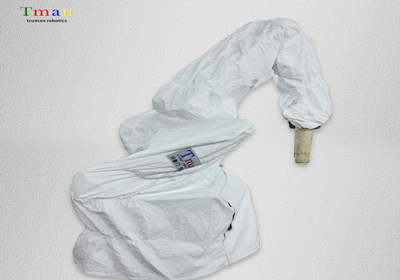
Dustproof robot cover is the most basic and widely used type in robot cover functional classification. In ordinary machining, assembly and logistics palletizing workshops, floating industrial dust, metal particles and oil stains are the main threats to robot equipment. Dust accumulation will block sensors, jam movable joints, and cause aging of internal circuits. Standard dustproof robot covers adopt high-density and wear-resistant fabric, which can fully wrap the robot body, effectively isolating dust and oil pollution. This type of robot cover maintains the cleanliness of robot precision components, reduces manual cleaning frequency, and is suitable for 24-hour continuous industrial operation.
Anti-static robot cover is a special functional protective cover for flammable and explosive spraying industries. In automatic spraying workshops, a large amount of paint mist and volatile solvent gas exist in the air. Frequent friction during robot operation easily generates static electricity. Static spark discharge may cause serious safety accidents. Different from ordinary dust-proof covers, anti-static robot covers are woven with conductive fiber materials, which can quickly release accumulated static charges on the robot surface, eliminate static adsorption, reduce paint mist adhesion, and improve spraying quality while ensuring workshop explosion-proof safety.
High temperature resistant robot cover is specially developed for high-heat working conditions such as welding, forging and hot stamping. In high-temperature industrial scenarios, welding spatter, thermal radiation and high-temperature air flow will cause thermal deformation of robot shells and burnout of electrical components. High-temperature resistant robot covers adopt multi-layer heat insulation and fire-retardant materials, which can resist strong thermal radiation and block high-temperature welding slag splashing. It effectively prevents robot precision parts from being damaged by high temperature, ensures stable positioning accuracy of welding robots for a long time, and greatly extends the service life of high-temperature operating equipment.
Constant temperature heating robot cover is a functional type designed for low-temperature environments such as cold storage, frozen logistics and northern winter workshops. When the ambient temperature is too low, robot lubricating grease solidifies, mechanical resistance increases, and electronic components are prone to parameter drift and condensation short circuit. The constant temperature heating robot cover is equipped with intelligent temperature control system, which can stably maintain the internal working temperature of the robot, prevent freezing failure, eliminate condensation, and ensure that the robot can start and operate normally in ultra-low temperature environments. It solves the problem of unstable operation of automated equipment in cold industrial scenes.
Anti-corrosion robot cover is an essential protective type for chemical, pharmaceutical and electroplating industries. Factory environments in these industries contain volatile corrosive gas, liquid mist and chemical residues, which will slowly erode robot shells, seals and circuit harnesses, leading to equipment aging and failure. The surface of the anti-corrosion robot cover is treated with special chemical resistant coating, which can isolate acid-base corrosion and liquid erosion, protect the robot body from chemical damage, and adapt to long-term operation in harsh chemical industrial environments.