Truss Robot (Gantry Robot): Working Principle, Features and Industrial Applications
Date:2026-08-03 Author:Truman Robotics Visit:1988
In modern intelligent manufacturing and automated logistics industries, truss robot, widely known as gantry robot, has become one of the most reliable and cost-effective automated handling solutions. Different from traditional six-axis articulated robots, truss gantry robot adopts Cartesian coordinate linear motion structure, realizing precise automatic handling, loading and unloading, palletizing and warehouse accessing tasks through X, Y, Z three-axis linkage. Due to its stable structure, large coverage and strong expandability, the truss gantry robot is increasingly applied in factory automation and intelligent warehouse systems.
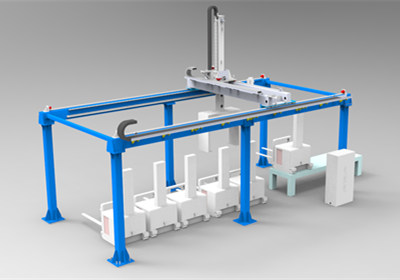
The working principle of the truss gantry robot is based on gantry frame structure and linear servo drive system. The overall rigid truss frame is installed above the working area, which effectively saves ground space. Driven by precision servo motors and ball screw or belt transmission systems, the robot executes accurate linear displacement in horizontal and vertical directions. Equipped with customized suction cups or mechanical grippers at the end, the gantry robot can stably grab, transport and place workpieces, realizing standardized and repetitive automatic operation in industrial production lines.
One of the most prominent advantages of the gantry robot is its ultra-wide operating range and high structural rigidity. The stroke of the truss robot can be customized according to workshop layout, spanning several meters or even tens of meters. A single gantry robot can cover multiple stations and complete cross-area material handling. Compared with articulated robots limited by arm span, the truss robot runs more stably with less vibration during high-speed movement, ensuring millimeter-level repeated positioning accuracy and effectively avoiding workpiece deviation and falling problems.
Strong load adaptability is another core feature of industrial truss robot. The gantry robot series covers light-duty, medium-duty and heavy-duty models. It can handle small cartons and parts as well as heavy pallets, molds and mechanical workpieces weighing several tons. This flexible load capacity makes truss gantry robots widely suitable for mechanical processing, new energy industry, chemical manufacturing, food logistics and other fields, meeting the automated handling needs of different production scenarios.
The modular design of thetruss gantry robot brings excellent scalability and low maintenance costs. The whole equipment adopts standardized modular assembly structure. Enterprises can independently adjust stroke length, running speed and load parameters according to production upgrades. Later capacity expansion only requires simple module upgrading without large-scale equipment replacement. Compared with other industrial robots, gantry robot has simpler mechanical structure, lower failure rate and more convenient daily maintenance, greatly reducing long-term operating costs for factories.
In intelligent warehouse and automated production line scenarios, the gantry robot can seamlessly connect with WMS, WCS and conveyor systems to realize fully unmanned material accessing, depalletizing, stacking and inventory management. It supports 24-hour continuous cyclic operation, effectively solving the problems of low manual efficiency, unstable rhythm and high labor cost, and greatly improving factory logistics turnover efficiency and production capacity.
NEXT: Core Functions of Truss Gantry Robot in Industrial Automation